
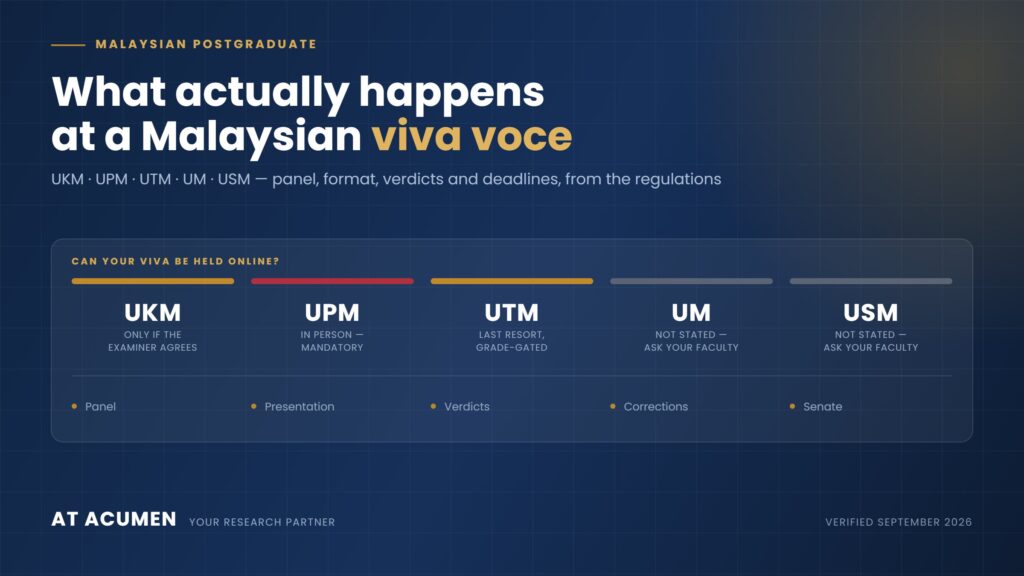
Most Malaysian postgraduates assume the viva is now normally held online. At three of these five universities that is no longer true. UPM made face-to-face compulsory again from Semester 1 of 2024/25. UTM permits online only as a last resort, and only if your thesis was graded well enough. UKM allows it only if the external examiner agrees. Here is what the regulations actually say about who is in the room, how long it lasts, what the possible verdicts are called, and how long you get to fix things afterwards.
The viva voce is the least documented part of a Malaysian postgraduate degree, and the part people worry about most. Your supervisor has been through it, but from the other side of the table. Your friends describe theirs, but at a different university with different rules. And the official regulations are written for examiners and administrators, not for you.
So we read the actual regulations at UKM, UPM, UTM, UM and USM — the oral examination guidelines, the graduate studies rules, the post-viva submission forms — and pulled out what a candidate actually needs to know.
The comparison
| UKM | UPM | UTM | UM | USM | |
|---|---|---|---|---|---|
| Panel | Chair + 1 internal + 1 external | Chair + 3 examiners for PhD (≥1 external); Chair + 2 for Master’s | Chair + 1 internal + 1 external | Committee of Examiners — chair, deputy dean, Senate rep, internal + external. Quorum 4 | Chair + dean or rep + 1 internal + 1 external |
| Your presentation | ≤ 20 min | Not stated | 15–20 min | PhD 20–25 min; Master’s 15–20 min | Not stated |
| Questioning | 60–90 min | Not stated | “One hour to one whole day” | Not stated | Not stated |
| Online permitted? | Yes — only if the external examiner agrees | No. Face-to-face mandatory since Sem 1, 2024/25 | Last resort only, and only for thesis grades A, B1, B2 | Not stated | Not stated |
| Minor corrections | 1 month (Cat 1) · 3–6 months (Cat 2) | 3 months | 3 months Master’s · 6 months PhD | ≤ 3 months | 6 months (Scale 2) |
| Major corrections | 6–11 months | 6 months | 6 months Master’s · 12 months PhD | ≤ 6 months | 9 months (Scale 3) |
| Re-examination | Up to 12 months | Not stated | Max 2 viva attempts | 6–12 months, once only | Up to 1 year (Scale 4) |
Scroll the table sideways on mobile.
1. The online viva is quietly disappearing
This is the single most out-of-date assumption we hear, and it costs people money — flights, leave, accommodation — when they find out late.
UPM is unambiguous. Its thesis page states that the viva voce is conducted face-to-face from the first semester of 2024/25 and that this is mandatory. The old “Guidelines for Conducting of Final Examination (Viva Voce) Online” page, live through the pandemic years, now returns nothing.
UTM still allows it, but has fenced it in. Online is framed as an exception for quarantine, visa problems, work-from-home directives or a health emergency — and, critically, it is only available to candidates whose thesis was graded A, B1 or B2. A grade of C or below needs the School of Graduate Studies to approve going online at all. For a PhD, the external examiner must attend the entire online session. Slides go in a week ahead, the connection is tested three days before, and the presentation is held to a strict 20 minutes.
UKM permits video-conference viva under its current regulation — but conditional on the external examiner consenting, not as a right you can claim.
For UM and USM we could not confirm a current general policy from the documents available. Do not assume. Ask your graduate school in writing, early enough to book a flight.
2. Your supervisor will be in the room and will not be allowed to help you
All five universities separate attending from deciding, and they are blunt about it.
- UKM — the supervisor is encouraged to attend but is tidak dibenarkan bersuara atau memberikan pandangan: not permitted to speak or offer an opinion, unless the committee invites it.
- UM — the supervisor may give an opinion “if necessary” but is not entitled to participate in decision making, and is asked to leave the room while the committee deliberates.
- USM — observer only. The SOP says a supervisor cannot assist the candidate with answers, except to clarify what a question means.
- UTM — required to attend, but not as an examiner.
- UPM — structurally excluded: an examiner may not be a member of your supervisory committee.
One UKM candidate described her supervisor sitting through the whole session in silence — “jadi patung cendana”, like a wooden statue. That is the design, not a failure of support. Plan your answers on the assumption that you are alone in that room.
3. The verdict names are not interchangeable
Every university has some version of pass, pass with minor corrections, pass with major corrections, re-examination, fail. But the labels and the deadlines attached to them differ, and people repeat the wrong ones to each other constantly.
- UKM uses Malay terms and splits minor corrections into two categories — kategori 1 (as little as one month, signed off by your supervisor alone) and kategori 2 (three to six months, needing the internal examiner too). It also records a separate quality rating: Cemerlang, Baik, Sederhana, Lemah.
- UPM says “accepted with distinction”, “accepted with minor modifications”, “accepted with major modifications”. Distinction gives you just 15 days to submit the amended thesis. Miss the deadline and Rule 52(v) says the thesis is deemed rejected and candidature terminated.
- UM’s Doctoral Regulations 2024 list seven outcomes, and one of them is not on anyone else’s list: the committee can certify you for the award of a Master’s degree instead, if doctoral merit is not met but Master’s merit is. UM also allows re-examination once only.
- USM numbers them: Scale 1 through Scale 5. Scale 4 is re-examination, and the second viva can only end in pass or fail.
- UTM is described in practice as an A–E grade, where D means the award of a lower degree and the oral defence may not be repeated more than twice. Note that this letter scale is the working terminology rather than confirmed Senate wording — check it with your faculty before relying on it.
Whatever the verdict, Senate has the last word. At every one of these universities the examination committee recommends and Senate confers. Your outcome on the day is provisional until Senate approves it — UM’s guidelines say this to the candidate explicitly at the end of the session.
4. What has to happen before a date even exists
The viva is the visible part of a process that starts months earlier.
The three-month notice is near-universal. UKM, UPM, UTM and USM each require a Notice of Thesis Submission, approved by your supervisor, at least three months before you intend to submit. That form is what triggers examiner nomination — nothing starts until it is in. UPM’s is GS-14a. If you have not filed it, you are further from a viva date than you think.
Then the examiners need time. At UKM the thesis goes to examiners within seven working days, they get six weeks to report, and the oral exam is scheduled within a month of both reports arriving. At USM, reviewers have roughly one month ten days for a Master’s and two months ten days for a PhD before a date can be set. One candidate reported a two-to-four month wait between submission and viva.
And the publication requirement can block you. This is where the universities diverge most sharply:
- UTM ties it to how fast you submit. Submit after 24 months and you need three indexed articles, two of which carry a cumulative impact factor of 6.0 or more. Submit at the conventional 36-month mark and one refereed article is enough. Finishing early costs you publications.
- UPM requires two articles in citation-indexed journals for a PhD, or one CIJ article plus one from an approved secondary category. Master’s needs one.
- UKM lets you sit the viva once papers have been submitted for evaluation, but the requirement must be complete before conferral.
- USM’s three-article requirement applies to the Thesis and Publication route rather than to every candidate.
- UM appears to set this at faculty level rather than centrally — so ask your faculty, not the university.
5. What it actually feels like
Regulations do not tell you the texture. These are candidate accounts, so treat them as impressions rather than rules.
A UKM candidate’s 2021 viva ran on Zoom for just over two hours with two examiners, one internal from another UKM institute and one external. The panel went chapter by chapter through a seven-chapter, 80,000-word thesis. She passed with minor corrections due within a month, needing only her supervisor’s sign-off.
Another candidate, at what appears from context to be UKM, presented for 20 minutes from 26 slides, then answered questions for about an hour and a half — and had one week’s notice of the viva date.
A UTM mathematics candidate presented for 25 to 30 minutes and was then walked page by page through a hundred-page thesis. His description is the most useful sentence we found anywhere: it was “a session to improve the thesis… a meeting between reader and writer”, not an interrogation.
How to prepare, in order
- File the Notice of Thesis Submission three months out. Everything downstream waits on it.
- Confirm the format in writing — online or in person — before you book anything. Given UPM’s reversal, do not rely on what a senior did in 2023.
- Check your publication status against your university’s rule, not against your friend’s. At UTM, check it against your submission timeline specifically.
- Rehearse to the clock. Twenty minutes is the common ceiling for the presentation, and it is enforced. Practise the version that fits, not the version you wish you could give.
- Prepare for chapter-by-chapter questioning, not thematic questions. Every account describes examiners working through the thesis in order. Know what is on your own page 47.
- Know your correction deadlines before you walk in, so that when you hear “minor corrections” you already know whether that means one month or six.
One honest caveat. Several figures on this page could not be confirmed for every university — UPM’s presentation length, USM’s and UM’s current online policy, UTM’s exact Senate wording for its grades. We have marked those rather than filling the gaps with plausible guesses. Confirm anything that affects a flight, a deadline or a decision with your own graduate school.
Getting ready for a viva, or working through corrections?
We work with postgraduate researchers across Malaysian universities on defending methodology, preparing for examiner questions, and turning a corrections list into a submitted thesis — on your own work, to your own institution’s requirements.
Sources — each university’s own regulations:
Universiti Kebangsaan Malaysia, Garis Panduan Pengendalian Peperiksaan Lisan Disertasi/Tesis (Edisi Semakan 2021) and Peraturan UKM Pengajian Siswazah 2021 — ukm.my
Universiti Putra Malaysia, Viva Voce Examination and Guidelines for Submission of Thesis After Viva Voce (12 Jan 2024), School of Graduate Studies — sgs.upm.edu.my
Universiti Teknologi Malaysia, Guidelines for Conducting Online Viva Examination (1 Dec 2022) and Peraturan Akademik Pengajian Siswazah (2024) — sps.utm.my
Universiti Malaya, Guidelines on Oral Examination (Viva Voce) Management (Senate-approved 25 Feb 2021) and UM (Doctoral Degree) Regulations 2024 — ias.um.edu.my
Universiti Sains Malaysia, SOP for Viva Voce and the Senate-approved viva guide, Institute of Postgraduate Studies — ips.usm.my
Read as published in September 2026. Regulations are revised without notice and faculties may apply stricter rules — confirm anything time-critical with your own graduate school. If you spot something that has changed, tell us and we will update this page.